The Importance of Bent Knees in the Sanchin Stance
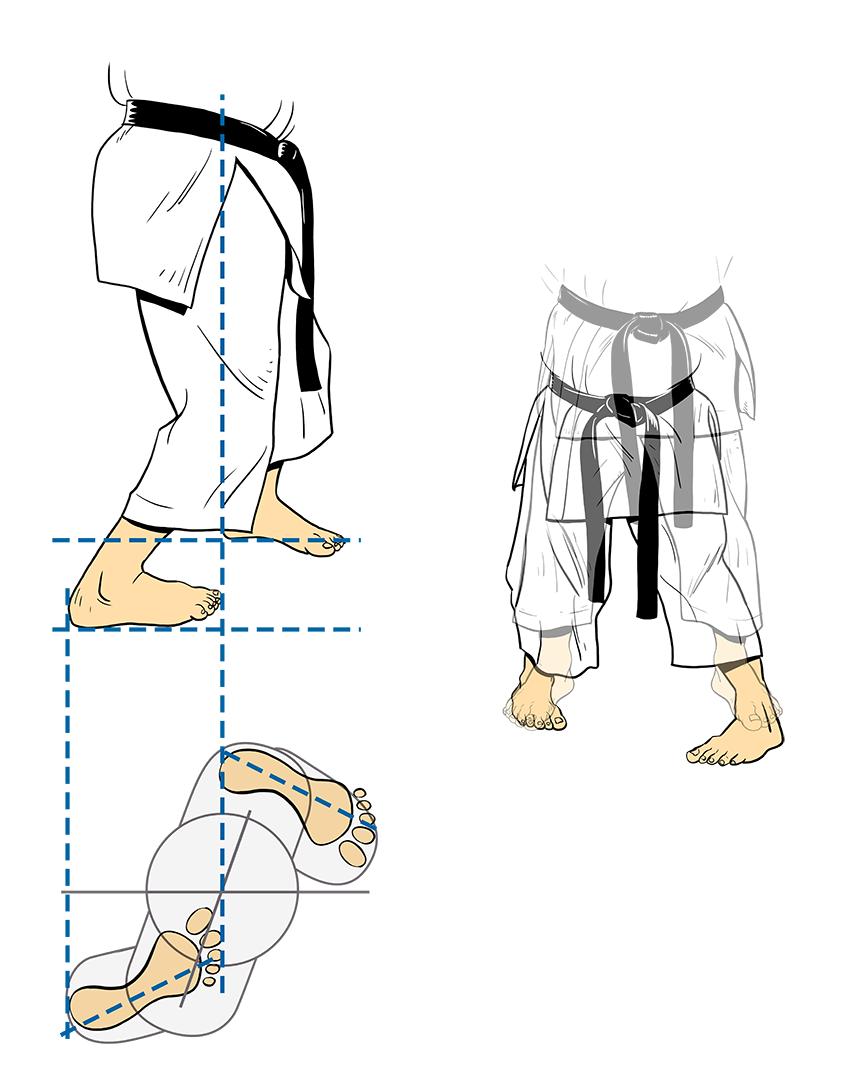 The Sanchin stance in Uechi-Ryu is less about a fighting posture in the conventional sense and more about building a body that can function under pressure. Its strengths and limitations come from that purpose.
Sanchin creates a compact, rooted base. The inward pressure of the legs and the engaged core produce a strong vertical structure that is hard to disrupt. This is especially useful in close-range exchanges where balance is constantly challenged.
The stance forces a connection between the legs, hips, and upper body. Movement originates from the center rather than from isolated limbs. This supports efficient force transfer, coordinated strikes, and better control under contact.
The Sanchin stance uses subtle inward engagement of the legs. That only works if the knees are slightly bent, which allows controlled inward pressure without stiffness. Too straight: no engagement is possible. Too bent: tension becomes excessive and slows you down.
The slight knee bend is a key point in Sanchin because it solves several mechanical problems at once. If you straighten your legs, most of what Sanchin is trying to build simply stops working.
For example, stand in Sanchin close to a wall and push it with your fist while keeping your knees straight. Then do the same with slightly bent knees. You should feel how power comes from the ground. The effort feels smaller, but the effect is stronger, and your body works as one unit.
Power in Sanchin doesn’t come from big movement; it comes from compression and release. Slightly bent knees preload the legs (like a spring) and allow force to travel from the ground → center → strike. This gives a kind of elasticity to the body. Straight legs remove that elasticity. No elasticity means no short power.
Slightly bent knees also protect your joints. If the knees are straight (locked), impact travels directly into the joints, and your structure becomes brittle under pressure. With slightly bent knees, force is absorbed by muscles instead of joints, and the body disperses impact rather than taking damage.
Another important point of slightly bent knees is readiness to move. Bent knees allow immediate stepping and weight transfer without delay. Straight legs force you to “unlock” before moving, and that delay matters.
So, the slight knee bend is not about a “lower stance.” It’s about this: are your legs acting like rigid sticks, or like springs? Sanchin only works when they behave like springs.
The Sanchin stance serves as the foundational architecture for practical self-defense, but in the fluid, rapid dynamics of sparring, Sanchin is rarely visible as a rigid, static posture; instead, it lives beneath the surface. Without learning to translate its core principles—like grounding, structural alignment, and core engagement—into free, adaptive movement, practitioners will struggle to utilize its immense defensive power in live, chaotic scenarios.
Bottom line: The Sanchin stance is a method for building an unbreakable body, and the bent knees are the master key that unlocks it all. It is this specific flexion in the knees that connects the practitioner to the earth, creating the spring-like leverage needed to stay stable under pressure, generate explosive power from the ground, and maintain a resilient structure while striking or receiving force. Without those bent knees, the stance loses its suspension, and the entire system collapses.
" Unlock the knees, unlock the power."