History
Karate is the martial art native to the island of Okinawa. A great deal of trade was done between Okinawa and China, including knowledge of various Kung Fu systems, parts of which were eventually combined with the native Okinawan martial art at the time, simply called Te (“Hand”), to make what we now know as Karate.
The island known as Okinawa, as well as islands around it, used to be called the Ryukyu Kingdom, until the 1800’s when Japan made it officially part of the nation. The capitol of Okinawa is Naha city. Karate is a word that means "Empty Hand", referring to an unarmed form of self-defense. Karate-Do means "The way of the empty hand", referring to Karate as a way of life. Indeed, the martial arts are known for instilling many virtues in its practitioners. These include Awareness, calmness, mental stamina, physical strength, and of course confidence.
Karate was first introduced and taught outside of China by an Okinawan man named Gichin Funakoshi who, like Kanbun Uechi, also went to China, learned a system of Chinese boxing, and taught it to his people. Gichin Funakoshi's style of Karate is called Shotokan, and is one of the main systems of Karate today.
Before the nineteenth century, the written character for Karate, while still written the same way, was pronounced as Kodite, meaning Chinese Hand. It wasn’t until Japan made Okinawa a part of the nation that the pronunciation changed to Karate, and the meaning changed to Empty Hand.
The karate styles in the Uechi Ryu family of Okinawan karate are based on the three kata taught to Uechi Kanbun by Shushiwa: Sanchin, Seisan and Sanseiryu. The single-knuckle punch (shoken), spear-hand strike (nukite), pointed-toe kick (sokusen) and circle block (wauke) are signature moves of the family.
 The Chinese Buddhist monk Chou Tzu Ho (1874-1926) was known to Okinawans as Shushiwa. He taught Pan Gai Noon (traditional Chinese characters: 半硬軟), a type of Chinese kempo, at the the Shoalin Temple in Southern China. Pan Gai Noon, meaning half hard soft, included techniques from the tiger, crane and dragon styles of kung fu.
The name Pan Gai Noon came from the two styles of Chinese kempo from which it derived. The first, Southern Shaolin Ken, consisted of hard body training and was primarily offensive. Emphasis was placed on fingertip (nukite) training. Practitioners were known for having fingers like iron. The second, Eishun Ken, was a soft style known for its defensive skills. Shushiwa is believed to have combined the two styles to create a system that used hard techniques for offense and soft techniques for defense.
Legend attributes Shushiwa with great strength. He reportedly could hold the weight of two men hanging from the fingertips of his outstretched arms. He also taught Chinese medicine and was an accomplished painter and calligrapher.
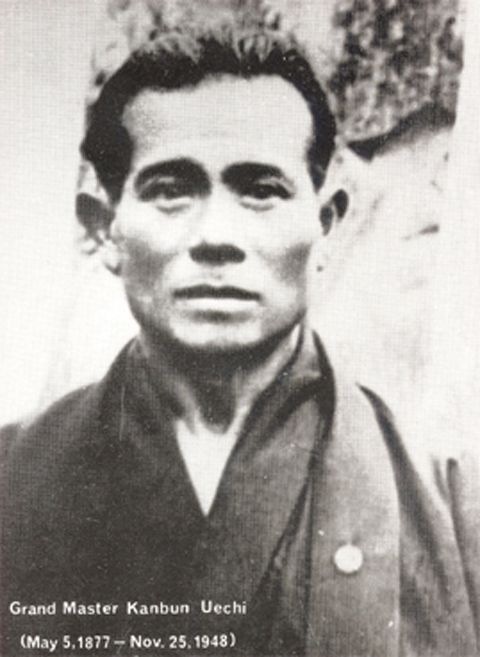 The history of Uechi-Ryu (Pronounced Way-CheeRoo), began in Okinawa on May 5th, 1877, with the birth of the founder: Kanbun Uechi. Kanbun was the oldest son of Samurai descendants Kantoku and Tsura Uechi.
In 1897, Kanbun left Okinawa for China in order to avoid a Japanese Military conscription. He arrived in Fuchow City, Fukien Province and began his martial arts training. For the next ten years, he studied Pangai-noon under the guidance of a Chinese Monk we know as Shushiwa.
The name Pangai-noon literally mean that the art's techniques are "half-hard, half-soft," referring to hard strikes and soft blocks. Shushiwa is believed to have studied the styles, Shaolin fist, Iron palm, and Tiger fist. Pangainoon is believed to be a combination of these styles.
Kanbun studied briefly at a karate school in a migrant Okinawan community in Fuchow, but a senior ranking student eventually drove him to leave by making fun of him for having a speech impediment. Soon after, he met Shushiwa.
An account of Kanbun’s acceptance into Shushiwa’s school, as told by Seiko Toyama and Kanei Uechi is as follows. One day, Shushiwa was stricken with a massive headache. His alarmed students called upon Kanbun to use his knowledge of medicine to alleviate Shushiwa’s suffering, which he did, using herbal mixtures. After which, Kanbun was accepted into Shushiwa’s school in a secret ceremony called Pai Soo.
In 1907, Shushiwa encouraged Kanbun to open his own school. He eventually did in Nansoe, a day’s journey from Fuchow. Kanbun was credited with being the first Okinawan to operate a school in China. The school ran successfully for three years, then one of his students killed a neighbor in self defense in a dispute over an irrigation matter. The incident hurt Kanbun to the point that he closed his school and returned to Okinawa. There he married, settled down as a farmer and vowed never to teach again. On June 26th, 1911, his first son Kanei Uechi was born.
In 1924 Kanbun Uechi, along with many other Okinawans, left his home and went to Japan for stable employment. He arrived in Wakayame and worked as a janitor. It was here that he met a younger Okinawan Ryuyu Tomoyose. It was through this friendship that Kanbun agreed to begin teaching in a limited capacity.
Before he died, his students would re-name the style from, then Pangainoon-Ryu, to Uechi-Ryu in his honor, as well as naming Kanbun as grandmaster.
Kanbun’s favorite pastimes were cockfighting (A game that pits two roosters against each other in a fight to the death while spectators bet on which will win), and playing a stringed Japanese instrument called the Samisen.
Kanbun’s favorite saying is “All is in Sanchin”, referring to his belief that everything one needs for self deffense lies in Sanchin kata.
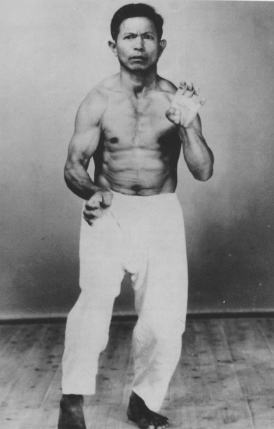 Kanei Uechi, son of Kanbun, like his father, he married an Okinawan (named Shige) and kept his martial arts practice from becoming public knowledge.
Some time later Ryuko Tomoyose, son of Ryuyu, approached Kanei and following the advice of his father, did everything he could to convince Kanei to begin teaching in Okinawa. Kanei resisted until Ryuko and several fellow farmers built a dojo for Kanei. Later, this was moved to its current location in Futenma and was called “Uechi Ryu Karate Family Headquarters Dojo” (a.k.a. “Soke”). Kanei and Ryuko stayed together for many decades and became the best of friends. A friendship which continued until Kanei Uechi died in 1991.
Ryuko Tomoyose has a long list of amazing accomplishments. In addition to becoming one of the highest ranking living martial artist in Okinawa, he was also given the title of National Living Treasure of Japan. He is also fluent in English. In 1956, with the permission of Kanei Uechi, he began teaching the first non-Okinawans Uechiryu Karate.
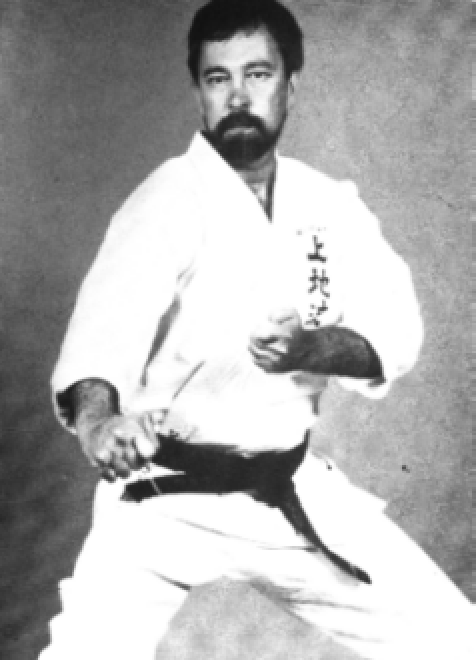 There have been several highly known nonOkinawan students. Two examples are, the late Ian Fleming, creator of James Bond, and George Mattson, who would become the first American to be promoted to Shodan (First Degree Black Belt). In 1958, Ryuko Tomoyose gave George Mattson two instructions for returning the United States: write a book and teach Uechiryu.
George Mattson began teaching at the YMCA in Boston and this grew into becoming the famous “Mattson Academy Of Karate”. It was at this school that many of the most remarkable Uechi practitioners began their training.
In 1963, George Mattson published his first book “The Way Of Karate”. This was the first hardcover publication of martial arts ever to be written in English.
In 1966, Buzz Durkin began his practice under the tutelage of George Mattson. In 1974, he opened his dojo is Salem, NH.
Currently, Kancho Uechi (Great-Grand son of Kanbun Uechi) is the headmaster of Uechiryu Karate-do.
TOMOYOSE RYUKO 友寄隆宏 (UECHI-RYU) 1928-2019

Tomoyose Ryuko was born on December 10, 1928 and was a senior student of the late Uechi Kanei. Tomoyose is presently ranked a Hanshi 9-Dan by the All Okinawa Karate-do Association. The date of the interview was July 20, 1991 and the location was at the home of James Thompson, Okinawa Uechi-ryu Kyoshi 7-Dan, located in Kalamazoo, MI. Tomoyose Ryuko speaks excellent English and needed no translator.
Interviewer: Sensei, can you please identify yourself.
Tomoyose-sensei: My name is Tomoyose Ryuko and I am presently ranked a Hanshi 9-Dan by the Zen Okinawa Karate-do Renmei. I was a student Uechi Kanei. I do not have a dojo but teach at various students' training halls. I am also the president of the Okinawa Karate-do Association.
Interviewer: In your seminar, you spoke of two kinds of karate. Can you please tell me about this again?
Sensei: Okinawans recognize two kinds of karate. One is called budo karate and the other one is sport karate. I teach budo karate - this is the traditional karate of Okinawa. A large number of people, especially in the United States, teach and practice sport karate. People are attracted to sport karate and that is okay -- for them, but it is not for me.
I choose budo karate because it is a way of life. Sport is only good when you are young and people have to understand that sport karate is not the real karate of Okinawa. Budo karate can include a little bit of sport in it, and that is okay -- a little is okay, but those that practice only sport karate find a distaste for the budo aspect.
There is also a danger in that many practitioners say they practice budo karate but their training does not reflect that -- they only think they practice budo karate, in some cases they even hope that they are practicing budo karate. They do not know because they may have never been exposed to it.
Interviewer: So, it is better or more desirable to practice budo style karate?
Sensei: Not everyone can or should practice budo karate. Budo karate is commitment and dedication. In this case you, as a budo karate teacher, have to pick those that you can teach real budo karate to. These individuals train hard and are mannerly in their ways. Budo karate is then a challenge to them -- and they can and will accept this kind of training.
Nowadays people concentrate on sport karate too much. They throw punches and kicks without any focus and without any commitment. In the old days, karate focused on one punch and one kick. People have gotten away from this philosophy. I teach this and I stress this philosophy. So now it is the only way I know -- and through training in this fashion you find that it is also the best way.
Sport karate is not for me or my students. We practice the budo style of karate. I am now teaching my grandson budo karate. All he knows now is budo karate. I have taught him for two years the principles and methods of sanchin. He is still working on it. Maybe one more year -- then I will teach him the kata sanchin.
One time he saw others practicing kata sanchin and said that it was clear to him that they did not know what they were doing. When you have one, two or three kata that are important -- like sanchin, seisan and sanseiryu -- it is necessary that you research deeply these kata. Not just the surface knowledge but the deep knowledge and understanding of budo karate kata. This is real karate kata knowledge.
Interviewer: Isn't budo style karate more strict -- rough -- to be teaching someone so young? Or can anyone start with budo?
Sensei: I teach my grandson budo karate because I truly love him. You cannot teach budo karate to everyone. Their character and their minds may not accept this method. So you must watch the students training and see how they are as people, as persons and as human beings. Are they honest? Do they train hard? Do they have strong but pliant minds? Above all, you must decide as to whether you can trust them and they must trust you as their teacher. When they give you this commitment then they can begin learning budo karate.
Budo karate stresses the toe kick and the single point fist. This is developing a true weapon. It is a hard way and not all can have the mind or determination to develop this. This is also a part of budo karate. The toe kick is budo karate. The ball of the foot kick is sport karate. Look to see which one is easier. The easier one relates to the sport aspect. The hard one is budo -- a hard road, a hard path but one that is followed by the warrior.
Interviewer: Do you think that today's students look for the easy way of learning? The easy way - whether its sport or budo? Even in the practice of toe kicking I see that most prefer the ball of the foot kick?
Sensei: Again I can say that sport karate is not for me -- even in shorin-ryu, the late Chibana Choshin-sensei used the toe kick. Nowadays the new practitioners look for the easy way and use the ball of the foot kick. That is okay -- they practice sport karate but it is not for me or my students. Do you use the toe kick?
To develop the toes you must practice balancing on your toes to toughen them. It is difficult to develop but anything worth having means hard work. You must work the toes all the time and they soon will develop into potent weapons -- every class I teach I practice balancing on my toes: it is now a habit.
Traditional Okinawan karate teaches kicking to the body but I see all these students working on their high kicks -- it looks good but, once again, that is part of sport karate. I tell them, it is okay for them to practice high kicks as long as they understand it is all part of sport. I don't teach sport but I don't discourage it.
The students ask about learning to fight. I tell them if they really want learn how to fight deadly, then buy a gun. Having a gun is a much better way of fighting. Learning budo karate takes a long time, learning to shoot a gun correctly takes about a day. Learning to kill with a gun takes even less time. Learning budo karate can take a lifetime.
Interviewer: You also spoke of the importance of kata sanchin. Please tell me more about this kata.
Sensei: Sanchin is the most important of all Okinawan karate kata to do. You must do kata sanchin or sanchin training everyday to build a strong body and a strong mind. Sanchin not only toughens the body but also helps you to develop a strong mind and an unflinching spirit. This is the heart of budo karate. All the major karate styles on Okinawa have practiced kata sanchin. Goju-ryu, and even shorin-ryu practiced the kata sanchin. I think that shorin-ryu has now dropped the kata and that is sad.
Interviewer: If there is something that needs to be changed here in the U.S.? What would you recommend?
Sensei: Right now there is too much fighting among followers. We must all work together and end all this fighting. The idea is to spread traditional Okinawan karate-do -- not to destroy it with the fighting among the seniors. Some people have small minds and try to cause trouble. All I say is that Okinawan karate means to work with each other and to help each other. I don't say bad things about others because I am not concerned about gossip. I have a hard enough time teaching good karate and worrying about the development of my students to be concerned about mere gossip.
If people do bad karate all I can say is that is good! It is good for them and for their group. I am happy for them. I cannot force them to change. They then see our karate and they either don't like it because it is too frightening or they see the truth of it and say "please help me learn budo karate." They must want to make the changes. It does no good in trying to force people to change. Just learn to focus on your own training and your own karate family; that is what really matters. That is what is really important.
Interviewer: Can you tell me about your karate family?
Sensei: In karate the family is very important. You have your real family and you have your karate family. They are both the same except in importance. Your real family always comes first and then your karate family -- but both are still your family. This is something very important that everyone should understand.
Interviewer: Can you tell me something about kata - Uechi-ryu kata.
Sensei: Okinawan karate has many kata. How many do you know -- I mean how many do you REALLY know. Not surface knowledge but knowledge of depth and understanding. The Uechi-ryu studies with depth three kata: the sanchin, the seisan and the sanseiryu. I think that any stylist should practice three kata with depth. A beginning form, an intermediate form and an advanced form. Practice and research for depth of kata. Then you are practicing and living budo karate.
Interviewer: I had never before met Takada-sensei. Can you tell me a little about this remarkable person?
Sensei: Takada is a great master. Uechi's kata sanseiryu and Takada's form are very close but I think that Takada's form is better. He is a great master. He has the attributes of a great master: he is quiet, humble and has great knowledge. I am happy to call him my friend.
Interviewer: Even among the same style, students studying under the same teacher, there are so many differences. Why is this so?
Sensei: Everyone's interpretation of what they learn can be and is different. That is okay because people are human and can make mistakes. Some make a big circle in this or that movement. Some make a smaller circle for the same movement. Who is correct? Both are correct if this is what they believe to be the truth. Does it work for them -- yes, or they would not be doing it that way. So it is okay. Both ways are correct.
Many people are so concerned about how they look. They want to look nice and have others see them so they can say -- they look nice. What is important is the fact that you -- YOU train hard. You train for yourself and not for others.
Karate is a personal thing. It is for you to become better. Karate is not to impress others or to be fancy. When students ask me about these fancy people, all I can say is that it is good for them and I'm happy for them. But it is not for me.
Interviewer: Sensei, you often have mentioned the difference between winning and losing. Can you give me some more information?
Sensei: Even in Okinawa there are many that do sport karate - I call this bullshit karate. Everyone knows them. But I think in the United States that there is more bullshit karate because you have so many more people. Even here I see students of my students practicing this. Bullshit karate is everywhere -- here in America and in my home of Okinawa.
Let us sit down and talk about budo karate and sport karate. Many students love to practice sport karate. Sometimes they ask me what I think of their methods of sport. I say that sport karate is bullshit karate. They never ask me that question again. That is okay -- if they do not want to hear the truth.
Bullshit karate is concerned only about winning -- for example, winning championships. Not everyone can win. So the champions are champions and the others -- they are losers because they did not win. So these practitioners of sport karate tell me that they are not champions then they must be the other, right? These people give excuses or say you don't understand sport. In the end the champion is still a champion and everyone else is a loser. What would you call them?
Winning and making others losers -- to me this is the real heart of bullshit karate. In budo karate we all train to make ourselves a better person. The only competition is within yourself. In this way we are all striving to be winners and champions. We strive to be better human beings, better people --this is a far more worthy goal then having a tin trophy. Others will argue over this but that is okay. It is okay for them to practice bullshit karate but for me, it is only budo karate. If they show me their bullshit karate I say that it is good -- it is good for them but it is not real karate and it is not for me.
This is a very important point for me. I cannot force people to accept my truth, I can just show them and then let them make the decision to follow or not follow. Which ever direction they follow, I will still practice budo karate!
Interviewer: Are there secrets in karate?
Sensei: Many students always look for short cuts or the easy way. They neglect the basics. The secret to any method of karate is in their basics. Constant attention and the practice of basics in a variety of forms is needed. In the old days it was okay to do many repetitions. It took me one year to learn all of the kata sanchin. Now students learn sanchin in one week. They then say -- what's next?
I taught my grandson sanchin stepping for one year. At the end of the year I then taught him how to turn around. Next year I'll teach him the whole kata. My grandson only knows this way and sees others and recognizes the fact that they are weak and wonders why they take the easy way.
Interviewer: Can you tell me about training. Do you recommend that we train everyday or every other day?
Sensei: It is important to train a little bit everyday. Maybe not long or hard but just a little. This is how you get strong. A lot of people train only once or twice a week. That is also okay but there is too much time between training sessions.
If you train a little everyday you slowly get better and better without a strain. You don't notice the progress because it is you. It is like hitting a makiwara. You hit it easy at first and then you slowly build up until you are hitting it quite hard but do not realize it.
Interviewer: So train a little everyday in order to keep on building yourself up. You continue to do this for the rest of your life?
Sensei: People have to realize that karate is for life -- so don't be in a hurry. If it takes you a long time to learn a kata or be proficient in a technique, that is okay. It is the fact that you are training that is important. Many people say that this is too hard and then it becomes a lot easier to quit.
There are many quitters in karate. You see them everywhere. "I took karate." "I know a little karate." "I use to be a white belt or brown belt or black belt." Now these people do not practice anymore but they have opinions about what is good karate and what is bad karate. It is like asking a loser's opinion on how to be a good loser. How can they give opinions when they know little to nothing about karate discipline or budo or the concept of "nin" (to endure).
Interviewer: Yesterday, we had an excellent discussion about training as tigers and sheep. May we talk a little more about this?
Sensei: Sometimes karate training can be called training as a tiger or training as a sheep. If you train as a tiger -- hard training and body conditioning -- you can always train with tigers. Other tigers will also recognize you and you can train in peace with them. They know that when two tigers really fight that one will die of injuries today and the other will die of injuries tomorrow. Both will die, so they have nothing to prove.
If you train like a sheep -- no contact and no two man conditioning -- then you can only train with sheep. A tiger can train with tigers and he can also train with sheep. He just has to be careful not to hurt them. A sheep cannot train with tigers. Sheep see tigers as being very frightening and their conditioning, he says, will cause cancer. A sheep training with tigers will get eaten up.
Sometimes you see a sheep who sees the truth of tiger training and changes. In reality this sheep was actually a tiger in sheep's clothing waiting to come out.
Watch people training. Look at how they act and how they behave. A tiger can be like a little kitty but dangerous even though he is friendly. They are quiet and watch everything. They listen and watch. They know who they are and they have nothing to prove -- they are at peace.
Sheep, on the other hand, make all kinds of noises and demand to be heard. They run around and seem to crave attention. They are easily hurt and easily scared. They always group together for their own protection. When danger approaches they look towards the group for protection because they cannot defend themselves. They are easy prey for the tigers -- whether it is one sheep or several, sheep are still sheep.