Karate (空手)
Karate (空手) (English /kəˈrɑːtiː/; Japanese pronunciation: [kaɽate]; Okinawan pronunciation: IPA: [kaɽati]) is a martial art developed in the Ryukyu Kingdom. It developed from the indigenous martial arts of Ryukyu Islands (called te (手), literally "hand"; tii in Okinawan) under the influence of Chinese martial arts, particularly Fujian White Crane. Karate is now predominantly a striking art using punching, kicking,knee strikes, elbow strikes and open hand techniques such as knife-hands, spear-hands, and palm-heel strikes. Historically, and in some modern styles, grappling, throws, joint locks, restraints, and vital point strikes are also taught. A karate practitioner is called a karateka (空手家).
Karate developed about 7 centuries ago in the Ryukyu archipelago, situated between the East China sea and the Pacific ocean. The islands names changed to Okinawa since its annexation to Japan in 1879. The oldest known document dates from 1409; written 3 years after the first Shō dynasty was created.
In the 18th century, Okinawa had a second wave of Martial-arts imported from China, especially by “Sakugawa-Tode” Sensei. The reason for his nickname; “To-dé” or “To-té”, comes from “To” which means “China”. This very same “To” has been replaced by a different version of the same Kanji to form “Kara” in 1936. It was made to fit for a better relation with Japan.
Karate was brought to the Japanese mainland in the early 20th century during a time of cultural exchanges between the Japanese and the Chinese. It was systematically taught in Japan after the Taisho era. In 1922 the Japanese Ministry of Education invited Gichin Funakoshi to Tokyo to give a karate demonstration. In 1924 Keio Universityestablished the first university karate club in mainland Japan and by 1932, major Japanese universities had karate clubs. In this era of escalating Japanese militarism, the name was changed from 唐手 ("Chinese hand" or "Tang hand") to 空手 ("empty hand") – both of which are pronounced karate – to indicate that the Japanese wished to develop the combat form in Japanese style. After World War II, Okinawa became an important United States military site and karate became popular among servicemen stationed there.
To compare with medicines, Karate is a generic name and brand-names (Ryu) share the same “active ingredient”, but have different characteristics, such as colors and flavorings, that do not affect the performance.
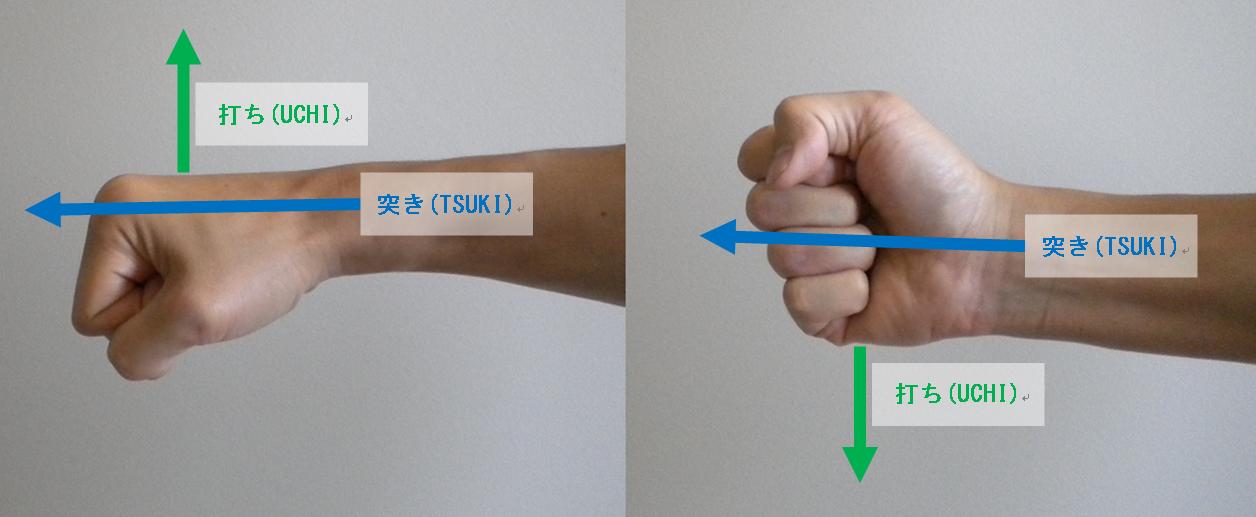
The main difference between Tsuki and Uchi
Tsuki -- The impact point of the fist moves to the same direction with the forearm
Uchi -- The impact point of the fist moves at (right-) angle of the forearm